
For years this was the dream of all SEO efforts: being ranked #1 on Google. Claiming the top spot, the clicks followed. There are plenty of sites that still rank first and still don’t get as many clicks as they once did because an AI-powered answer is now displayed at the top of the results, and it answers the search query without the user even scrolling down.
The change has thrown many site owners into confusion and uncertainty about what they are supposed to optimize for. Is classic SEO dead? Should you rethink your entire content strategy altogether in light of AI Search? The truth is somewhere between these extremes — and knowing the actual differences between AI Search and Google Search is where you’ll find the key to having a successful strategy for both.
This guide explains exactly how AI Search SEO differs from classic Google Search SEO, what on-page factors still are relevant (and which ones are more so now), and how to structure a strategy that both classic and AI-driven search results will consider relevant.
What Is Traditional Google Search SEO?
Google’s old-style search results are the familiar list of blue links that appear in Google’s result page that are based on the site’s relevance, authority and technical performance; this is called Traditional Google Search SEO.
It operates in a familiar way: Web crawlers find pages, add the content to the index, and rank them based on millions of other pages, using hundreds of ranking factors. Some of these signals include content relevance to the search query, backlink authority, technical health of the page, and how well a page satisfies search intent.
In traditional Google Search SEO, the site is optimized to achieve high rankings in the standard (organic) search results provided by Google.
Organic search was always the driving force of most websites’ traffic. Ranking high meant having visitors flow in and out of your site regularly, without a lot of hassle — and that’s why SEO has grown into such a valuable field in the last 20 years.
What Is AI Search SEO?
AI Search SEO involves optimizing content for systems such as Google AI Overview, Google AI Mode, Copilot, ChatGPT Search, and Perplexity, which generate answers using AI.
AI Search tools give an answer, rather than a ranked list of links, by combining information from many sources, and may mention only a few of these sources in the answer itself. The searcher might not even click through to a website, just reading the generated response.
For a lot of searches, Google AI Overview shows up on top of the ordinary search results, offering a summary from content sourced from a number of different sources. With Google AI Mode, you’ll get a fully conversational search experience. ChatGPT Search seamlessly adds real-time web answers into conversational answers. Perplexity AI was developed from scratch as an answer engine, referencing sources in-line. Microsoft Copilot combines the search index from Bing with answers from conversational AI.
The difference from traditional search: AI Search systems extract and synthesize information from pages to form one answer, while traditional search ranks pages for the human to browse. While it may redefine success, being cited in that answer — even without a click — is an effective way to get visibility and brand exposure.
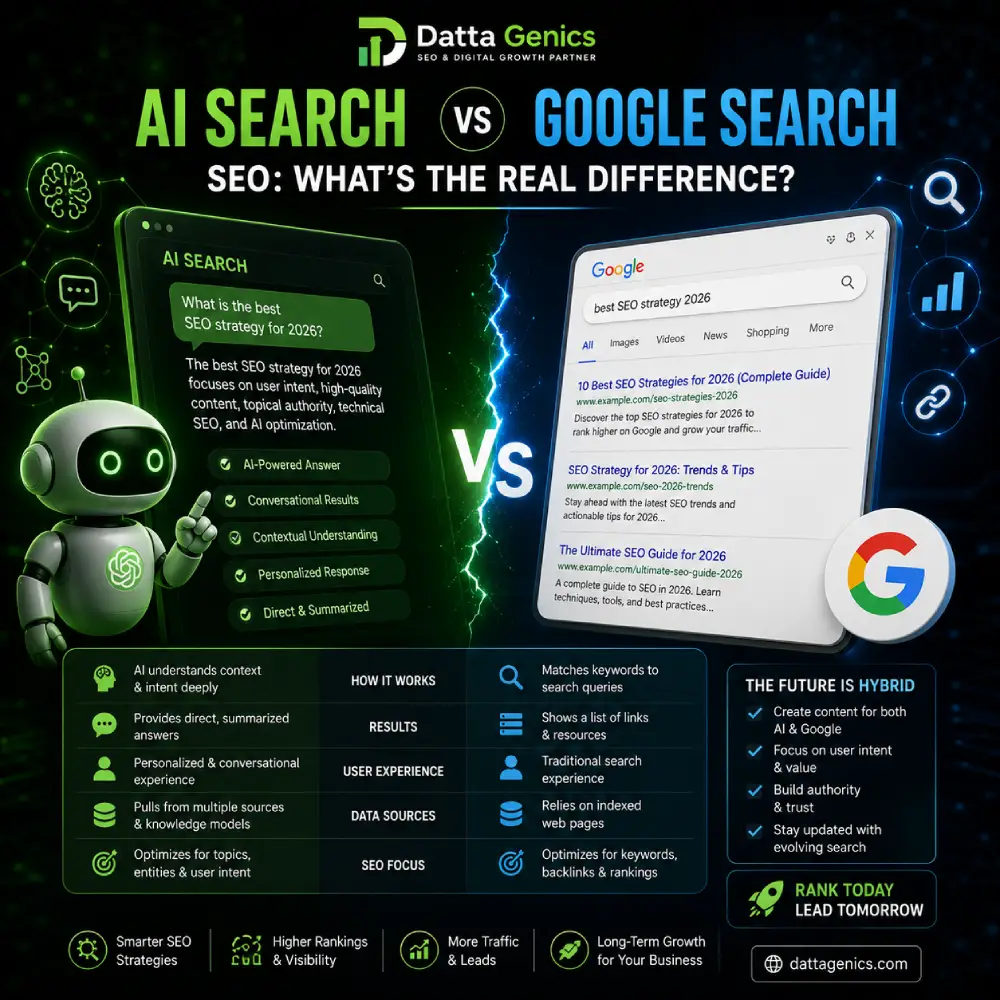
AI Search vs Google Search SEO: Key Differences
| Factor | Traditional Google Search | AI Search |
|---|---|---|
| Search process | Crawls, indexes, and ranks pages | Gathers and combines information from several sources into a response |
| Ranking factors | Backlinks, relevancy, technical SEO, E-E-A-T | Clarity, accuracy, logical organization, entity relevance |
| User behavior | Visits a ranked page | Often reads the answer without clicking |
| Content structure | Long-form, keyword-optimized pages | Clear, well-structured, scannable answers |
| Citations | Single click to one destination | Several sources combined in one response |
| Traffic patterns | Direct organic clicks | No guaranteed traffic, but brand exposure |
| Search intent | Matched to a single page | Matched to a synthesized, sometimes multi-part answer |
| Content depth | Rewarded with a full page visit | Rewarded with clear, directly answerable sections |
| Keyword usage | Exact and related keyword matching | Semantic and conversational language matching |
| Entity optimization | Useful but not dominant | Central to how AI systems understand and link themes |
| E-E-A-T importance | Significant ranking factor | Equally, if not more, crucial for source trust |
| Technical SEO | Crawlability and indexing are crucial | Content must still be relevant and machine-readable |
| Schema markup | Enables rich results | Helps AI systems interpret content more rapidly |
| Freshness | A ranking factor depending on query type | Heavily weighted, especially for fast-changing topics |
| Authority | Built through backlinks and reputation | Built through consistent citation across sources |
| Featured snippets | A specific structured output format | Closely related to AI Overview, since answers are often short |
| AI citations | Not applicable | A key new visibility metric to track |
How Google Search Works
Google’s normal search procedure is very broad and goes through three stages.
- Crawling — Google pages are found by bots or programs that follow links across the web.
- Indexing — The content is stored and organized in Google’s vast database for quick retrieval during a search.
- Ranking — When a real query is made, Google’s ranking algorithms check the index and weigh hundreds of signals to determine the order of results.
The Helpful Content System is an ongoing initiative focused on content created with humans in mind, not just to please Google’s algorithm. It favors quality over thin, keyword-stuffed pages.
Throughout the whole process, search intent is used as the anchor. Google isn’t just matching words — it’s trying to understand what the searcher really wants and getting them the most appropriate page to match that search.
How AI Search Works
The inner workings of AI Search systems are quite different.
- Large Language Models (LLMs) generate content in response to queries by predicting text based on patterns learned from massive amounts of text, combined with real-time data retrieval from the web.
- Natural Language Processing (NLP) lets AI Search interpret queries as spoken language rather than simple keyword strings, allowing it to respond well to longer, more complex questions.
- Multiple source citations are typical, as AI Search tends to combine information from multiple pages into one coherent response instead of pointing to a single one.
- Entity understanding matters more than exact keyword matching. AI systems link concepts, people, places, and things (entities) and how they relate — so content that’s clear about its subject matter, and how topics relate to each other, is more likely to be included in answers.
- Query fan-out is a technique some AI Search systems use, where a single query triggers a series of related queries in the background to gather a broader base of information for the final answer. This means your content may get pulled into an answer via a related sub-question, not just the exact query typed.
- Semantic understanding ties it all together — AI Search focuses on covering the meaning of a topic rather than exact keyword usage.
Which Are the Most Important Ranking Factors?
Some factors are weighted heavily by both systems; others matter more to one than the other.
- Search intent is crucial — mismatched intent hurts both traditional rankings and AI-driven answers.
- Topical authority — real depth across multiple related pages, not just one lucky article — matters increasingly to both systems, and arguably more to AI Search, since AI systems use it to decide which sources are trustworthy enough to cite.
- Backlinks remain a powerful signal for Google’s traditional algorithm. Their relevance to AI Search is less direct, but sites with strong backlink profiles tend to already be recognized authorities in their field.
- Schema markup helps both systems — it powers Google’s rich results and helps AI systems process content accurately and quickly.
- Technical SEO fundamentals (crawlability, fast loading, clean structure) remain essential for both. Well-written content that a crawler can’t access or parse won’t get cited, regardless of quality.
- Internal linking helps both systems understand how your content relates and reinforces topical authority.
- Content freshness matters more for time-sensitive queries, and AI systems especially favor fresh, verifiably current content.
- Brand authority, built through consistent mentions and recognition across the web, is increasingly weighed by AI systems.
- User experience (Core Web Vitals, mobile-friendliness) remains central to Google’s traditional rankings, and indirectly benefits AI Search visibility too, since a fast, well-structured site is easier for both crawlers and AI models to process.
How to Optimize for Both AI Search and Google Search: Step-by-Step Guide
This is the approach used across many SEO projects to create content that works in both systems simultaneously.
Step 1: Match Search Intent
Identify what the searcher actually wants before writing. A commercial query needs comparative material; an informational query needs a clear, direct explanation. This matters just as much for AI Search — no matter how well-optimized the wording is, the system pulling together an answer still needs content that actually answers the underlying question.
Example: Someone searching for “the best CRM for small teams” is better served by a comparison than a personal opinion blog post — both Google and AI Search systems favor the former.
Step 2: Develop Comprehensive Content
Depth still matters. The more a post covers a topic fully — including related subtopics, follow-up questions, and real examples — the more topical authority it builds, benefiting both traditional rankings and AI Search. Thin, surface-level content no longer works in either system.
Step 3: Show Experience (E-E-A-T)
Demonstrate competence rather than just claiming it. Use original examples, author bios with real credentials, first-hand knowledge, and experience-based statistics rather than generic summaries. One of the clearest differences between content that gets cited by AI Search and content that doesn’t is how much the system trusts the source.
Step 4: Organize Content for AI
Content that’s easy to extract and summarize is favored by AI Search systems. That means:
- Concise, direct answers near the top of relevant sections
- Subheadings phrased the way people actually ask questions
- Bullet lists and numbered steps instead of long paragraphs
- Comparison tables for multiple options
- Callout boxes for definitions and key takeaways
- A consistent, readable layout throughout
A technically correct article is only half the job — if an AI system can’t pull a clean, quotable answer from the structure, the content isn’t serving its purpose.
Step 5: Enhance Technical SEO
Good technical SEO is essential for both systems. Prioritize:
- Strong Core Web Vitals scores for loading speed and interactivity
- Mobile-friendly design, since most search activity happens on mobile
- HTTPS as a baseline trust and security signal
- A clean, updated XML sitemap
- A correctly configured robots.txt that doesn’t block key pages
- Structured data so both traditional and AI crawlers understand content and context
Step 6: Build Authority
Authority still has to be earned, not claimed. This includes:
- Earning credible backlinks from reputable, relevant sites
- Securing mentions and publications through digital PR
- Growing brand mentions across the web (even unlinked ones), since AI systems increasingly treat these as trust signals
- Using internal linking to deepen content and connect related information
- Building comprehensive topic clusters instead of isolated articles
Benefits of Traditional Google SEO
- Predictable click-through traffic — a top ranking continues to drive organic visits.
- Well-developed tools — mature tools exist for tracking rankings, traffic, and conversions.
- Established best practices — technical SEO and content quality fundamentals are well-known and proven.
- Direct monetization path — traffic to your own site is easier to monetize (ads, products, leads) than an AI citation.
- Longevity — well-optimized pages can rank and drive traffic for years with proper maintenance.
Benefits of AI Search SEO
- Visibility beyond the top 3 — strong content can be included in an AI-generated answer even without a top-three ranking.
- Reach — AI citations can expose a brand to audiences that a normal search result might not reach.
- Better answer extraction — structured content performs well in Featured Snippets and other structured formats.
- Exposure without clicks — being mentioned by name in an AI response builds visibility even if the user never clicks through.
- Early-mover advantage — optimizing now creates a head start as more search behavior shifts toward conversational, AI-driven tools.
Can You Rank in Both?
Yes — and in practice, this should be the goal rather than choosing one over the other. Fundamentals rewarded by both systems include clear intent matching, genuine topical authority, strong E-E-A-T, solid technical SEO, and well-structured content.
Across many SEO campaigns, content that has real substance, strong structure, and genuine expertise tends to perform well in classic organic rankings and get featured in AI-generated answers. Both systems are ultimately looking for the same thing: content that truly meets the searcher’s intent. Treating AI Search and Google Search as separate strategies is usually a mistake — treating them as overlapping goals built on the same foundation tends to work much better.
Common Pitfalls to Avoid
- Ignoring AI Search entirely. Sites that don’t optimize for it miss out on growing visibility through AI-generated answers.
- Ignoring Google fundamentals. Chasing AI citations without solid technical SEO and link building creates an unstable base for both systems.
- Keyword stuffing. Repetitive keyword use hurts readability and works against AI Search’s more semantic, conversational understanding.
- Thin AI-generated content. Content lacking real knowledge or original thought underperforms in both systems, especially under growing scrutiny of low-value content.
- Missing author credentials. Content without clear author information, credentials, or experience reads as less authoritative to both Google’s ranking systems and AI Search’s source selection.
- Poor technical SEO. Every other optimization is pointless if crawlers — traditional or AI — can’t access and process your content.
- Skipping schema. Without structured data, you lose an easy way to help both systems quickly understand your content.
- No topical authority. Isolated articles disconnected from a broader content strategy don’t build the depth either system increasingly rewards.
- Writing only for algorithms. Over-optimizing at the expense of real usefulness tends to backfire in both systems, since both are ultimately designed to reward helpfulness.
Best Practices for 2026 and Beyond
- Semantic SEO is growing in importance as both Google and AI Search systems get better at understanding language in context.
- Entity SEO helps both systems place your content correctly within their understanding of a topic.
- Topical maps act as a blueprint for every subtopic in a niche, letting you build real depth incrementally over time.
- Content clusters built around pillar pages with strong internal linking remain one of the best ways to demonstrate topical authority to both systems.
- Optimizing for AI Overview means organizing key information clearly and concisely near the top of relevant sections, where it’s most likely to be extracted for a summary.
- AEO and GEO — Answer Engine Optimization and Generative Engine Optimization — are newer, specialized fields focused on visibility in AI-generated answers, worth understanding even if your core strategy stays traditional.
- Brand authority grows through frequent mentions, repeat visibility, and consistent presence — all of which shape how trustworthy AI systems consider a source for citations.
- Fresh content and regular updates keep both systems seeing your content as relevant, especially for fast-evolving topics.
- Plan around full topic intent, not a single keyword, to optimize performance across both search paradigms.
AI Search SEO Checklist
- Search intent matches content format
- Content is organized with scannable headers, bullets, and short answers
- Schema markup is used where applicable
- Core Web Vitals and mobile performance tested
- Author expertise and credentials clearly shown (E-E-A-T)
- Content is connected to a broader body of content on the topic
- Internal linking to related content is in place
- Freshness reviewed — is anything outdated?
- Strategy underway to earn backlinks and brand mentions
- Content is clear enough for an AI system to extract a clean answer
Conclusion
Traditional SEO isn’t going out of style — it’s evolving alongside AI Search, not being replaced by it. The basics of search intent, authentic authority, and helpful content are as crucial as ever. What’s changing is how content is found, summarized, and presented to the searcher.
The best path forward for 2026 and beyond isn’t choosing between optimizing for Google Search or AI Search. It’s building content strong enough, clear enough, and structured enough to earn visibility in both — since both are ultimately trying to reward the same thing: content that genuinely solves what someone came looking to solve.
Frequently Asked Questions
Is AI-driven search replacing Google Search? Not entirely. Google AI Search has become part of Google’s own search results — AI Overview and AI Mode are built into its existing products — so this is more of an evolution than a revolution.
AI SEO vs. traditional SEO: what’s the difference? Traditional SEO focuses on ranking a page in a list of organic results through keyword relevance, backlinks, and technical execution. AI SEO focuses on earning citations or references within AI-generated answers, emphasizing clarity, structure, and semantic understanding.
Can AI Search drive more traffic to your website? It can, but typically not as directly as conventional rankings. AI citations don’t guarantee clicks, but they can generate brand visibility and impressions that lead to valuable referral traffic over time.
Does Google AI Overview completely replace organic results? No. It doesn’t replace traditional organic results, but it can reduce click-through for some queries since the searcher may already have their answer from the summary.
Is there still a place for backlinks? Yes. Backlinks remain a significant authority signal for traditional Google rankings, and a strong backlink profile also signals credibility to AI Search.
Why is schema crucial for AI Search? Schema markup helps both traditional search engines and AI systems interpret the structure and meaning of your content more efficiently.
What is GEO? Generative Engine Optimization — the practice of optimizing content to rank well in AI-driven answers on platforms like ChatGPT Search, Perplexity AI, and Google AI Overview.
What is AEO? Answer Engine Optimization — structuring content to directly and explicitly answer specific questions, increasing its chances of being selected for formats like Featured Snippets or AI Overviews.
What should you consider when optimizing content for ChatGPT Search? ChatGPT Search favors accurate, well-organized, clearly structured content that’s easy to trust and demonstrates real topical depth and expertise.
Should businesses invest in AI Search for 2026? Yes, generally — a mix of classic SEO tactics and content designed for AI-generated responses tends to produce the best combined results.