
Building topical authority can be a daunting process. Lots of sites publish dozens, if not hundreds, of articles and still don’t get any consistent rankings. It doesn’t have to be bad content — the issue is that Google, most of the time, simply doesn’t consider the website an authority on the topic.
It used to be enough to publish individual articles. It isn’t anymore. Today’s search engines — and the AI systems layered on top of them — value sites that show genuine, connected depth of understanding on an entire subject, not a hodgepodge of whatever was interesting to write about that week.
That’s why topical authority is one of the top SEO strategies to adopt in 2026. It’s the difference between a site Google deems important enough to show for top-level terms, and a site that stays on page two no matter how much content it publishes.
This is a comprehensive, step-by-step approach to topical authority you can follow start to finish. By the end, you won’t just have a definition to remember — you’ll have a working system to apply.
What Is Topical Authority?
Topical authority is how well users and search engines perceive a site as a reliable, in-depth resource for a certain topic.
It’s built through depth, not volume. A hub of 20 well-connected, thorough articles covering every meaningful aspect of a topic will usually beat a site with 200 thin, disjointed articles spread across 12 different topics. Google favors topical authority because it reflects real-world expertise — a real expert doesn’t just know one fact, they know the entire subject.
Definition: Topical authority is a measure of how trusted and knowledgeable a website is on a particular topic, based on content that’s extensively interconnected and comprehensive rather than a collection of individual articles.
Why Topical Authority Matters
Building topical authority delivers a number of tangible benefits:
- Higher rankings — a site with in-depth knowledge on a topic tends to get new content in that field indexed and ranked more easily, since Google already trusts the site’s expertise there.
- Google AI Overview visibility — AI systems tend to trust sources that appear consistently authoritative on a subject, since they’re essentially deciding who to quote.
- Better crawl efficiency — a well-structured, internally linked topic cluster helps search engines find and understand new content faster.
- Increased trust — extensive coverage signals to both algorithms and humans that a site is knowledgeable, not superficial.
- Improved organic traffic — articles grouped into a strong topical cluster generally outperform the same number of standalone articles.
- Brand authority — over time, a site with real topical depth becomes the source everyone else cites, earning natural backlinks, mentions, and repeat visitors.
Example: A site with one article on “email marketing tips” and an unrelated article on travel and recipes will struggle to rank for competitive email marketing keywords. A site that builds out a full email marketing knowledge base — tools, automation, segmentation, deliverability, copywriting — sends a much stronger signal to rank across all of those topics.
Understanding Topical Authority in SEO
Google doesn’t use a single metric to determine topical authority — it’s a structure built from several systems working together.
- Entities are the people, places, things, and concepts Google’s systems recognize in content. Using entities consistently and accurately helps Google better understand what a site is about.
- Semantic relationships describe how entities connect to each other. Clearly demonstrating these connections reinforces topical depth — if every article stands alone, they may as well be islands.
- Google’s Knowledge Graph is a structured database of entities and their relationships. Strong topical authority increases the likelihood that a site’s content gets linked to the entities relevant to its subject.
- Search intent remains central — even the best topical coverage in the world fails if individual pieces don’t match what people are actually searching for.
- Query fan-out is when AI-powered search systems generate several related sub-queries from one original query, pulling from different pages to build a “full answer.” Strong topical coverage increases the odds your content shows up across multiple related searches.
- Topical relevance is a narrower measure of whether a specific piece of content — and the site as a whole — is relevant to a given topic.
- The Helpful Content System rewards content genuinely created to help people, and topical depth is a natural byproduct of real helpfulness — you can’t publish a lot of thin content on a topic and credibly claim expertise.
- At scale, topical authority ties closely to E-E-A-T (Experience, Expertise, Authoritativeness, Trustworthiness) — the manifestation of genuine subject-matter expertise.
Topical Authority vs. Domain Authority
These two terms are often confused, but they measure different things.
| Factor | Topical Authority | Domain Authority |
|---|---|---|
| Definition | Depth of knowledge and trust in a specific area | Overall strength of a site, including its backlink profile |
| Purpose | Signals subject-matter expertise to search engines | Indicates overall site trustworthiness and strength |
| Ranking impact | Improves ranking within a specific topic area | Provides broader trust across the whole site |
| Backlinks | Useful, but not central | A central factor in calculation |
| Content quality | Built directly through extensive, interconnected material | Indirectly affected — good content earns links |
| Topic coverage | The core variable being measured | Not directly considered |
| Trust | Built through demonstrated expertise in one area | Built through the site’s reputation and history |
| Measurement | No single official metric — implied by rankings and visibility | Also estimated by third-party tools, not Google itself |
| Example | A site trusted specifically for SEO topics | A well-established site with a strong reputation across many subjects |
It’s entirely possible to have strong domain authority and weak topical authority in a given niche — and vice versa: a smaller site can have strong topical authority in its niche despite modest domain authority.
How to Build Topical Authority: Step by Step
This is the 10-step process applied across many SEO projects.
Step 1: Select One Core Topic
Concentrate on a single major topic instead of spreading content across unrelated fields. It’s nearly impossible to build authority on five different subjects at once.
Examples of a focused core topic:
- Home coffee brewing
- Technical SEO
- Personal finance for freelancers
Common mistakes at this stage:
- Choosing a topic too broad to cover well within a reasonable timeframe
- Mixing several unrelated topics on the same site
- Picking a topic that can’t realistically support dozens of connected pieces of content
Step 2: Build a Topical Map
A topical map is a hierarchical plan containing all the subtopics under your core topic.
Building one involves:
- Topic research — identifying every meaningful angle within your core topic
- Parent topics — the broad categories your subject breaks down into
- Subtopics — more specific angles within each parent topic
- Content hierarchy — structuring content from pillar down to supporting pieces
- Entity mapping — identifying related tools, concepts, people, and subjects that should appear in each piece
Example topical map for “home coffee brewing”:
- Parent Topic: Brewing Methods
- Subtopic: French Press vs. Pour Over
- Subtopic: Best Coffee Machines for Home Use
- Parent Topic: Coffee Beans & Grinding
- Subtopic: Types of Coffee Beans and Grinding Techniques
- Subtopic: Best Coffee Grinders
- Subtopic: Storing Coffee Beans Properly
- Subtopic: Light Roast vs. Dark Roast
- Parent Topic: Tools & Accessories
- Subtopic: Best Coffee Scales
- Subtopic: How to Maintain Your Coffee Maker
Step 3: Research Semantic Keywords
Once your topical map exists, populate it with real keywords.
- Start with a seed keyword (a broad term describing each parent topic), then expand to long-tail keywords that answer specific searcher questions.
- Use keyword clustering — group a core set of related keywords into one piece of content instead of spreading them across competing pages.
- Pay attention to search intent and related entities that should appear in the content. Google’s own suggestions and the “People Also Ask” box can surface angles you hadn’t considered.
Step 4: Create Pillar Pages
A pillar page is a thorough, all-encompassing article that anchors a section of your topical map, organizing and linking out to more specific supporting content beneath it.
A strong pillar page:
- Covers the parent topic thoroughly at a broad level
- Links out to all relevant supporting articles in that section of the map
- Gets linked back to by each of those supporting articles
- Naturally targets broader, higher-volume keywords for the topic
Example: “The Complete Guide to Home Coffee Brewing” links out to articles on French press brewing, recommended grinders, and bean storage — and each of those articles links back to the main guide.
Step 5: Build Supporting Content
Beneath each pillar page, supporting content provides the specific details:
- Cluster articles — in-depth pieces focused on one subtopic
- Supporting guides — practical, how-to content
- Case studies — real examples demonstrating results or experience
- Tutorials — step-by-step instructional content
- Comparison articles — helping readers make decisions
- FAQs — directly answering common, specific questions
Every piece should serve a real purpose, not just exist to fill a convenient keyword slot.
Step 6: Strengthen Internal Linking
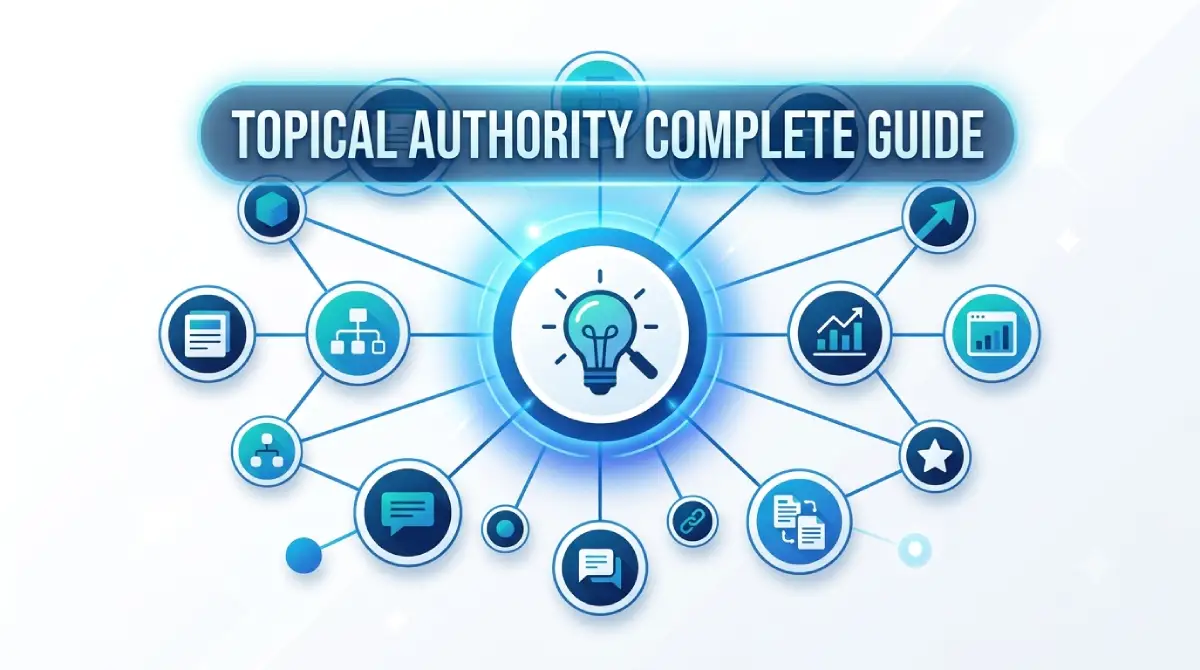
A topical map isn’t just a collection of related articles — it’s a content cluster connected through internal linking.
- Use contextual links within body content, not just navigation menus
- Use descriptive, relevant anchor text
- Build a clear link hierarchy where pillar pages link to all related supporting content
- Keep clusters consistent as new content gets added
- Pay attention to link equity — make sure your most important pages are well linked from within the site
One of the most common issues seen across SEO sites: dozens of related articles with little to no internal linking between them — which largely cancels out the topical authority benefit internal linking is supposed to provide.
Step 7: Demonstrate E-E-A-T
Topical authority and E-E-A-T go hand in hand — content needs to actually show the expertise it claims.
- Experience — first-hand accounts, personal testing, direct involvement in the subject
- Expertise — clearly researched, accurate content
- Authoritativeness — built gradually as topic depth and recognition grow over time
- Trustworthiness — transparent, accurate, well-sourced content
In practice, this means detailed author qualifications, first-hand experiences woven into the content, authentic (not stock) images, real-world examples, and citations from credible sources.
Step 8: Keep Content Fresh
Building topical authority isn’t a one-time project — it requires ongoing maintenance.
- Schedule regular updates for older content, especially in fast-changing topics
- Remove or correct information that could mislead readers or damage trust
- Fold new subtopics into existing articles as your topical map evolves
- Add new statistics and current data to keep content relevant
- Revisit and strengthen internal links as new supporting content is published
Step 9: Optimize for AI Search
With the rise of Google AI Overview, AI Mode, and other AI-powered search features, topical authority now plays an even bigger role in visibility.
- Use question-based headings that mirror how people actually search
- Place clear, extractable answers near the top of relevant sections
- Use schema markup to help both traditional search engines and AI systems interpret content precisely
- Apply principles from Answer Engine Optimization (AEO) and Generative Engine Optimization (GEO) — strategies focused specifically on visibility in AI-generated responses
The same topical depth that drove rankings historically is what helps AI Search systems decide which sources to trust and cite.
Step 10: Measure Growth
Topical authority builds over time — measure it accordingly.
- Track overall traffic trends for the whole topic cluster in Google Search Console, not just individual pages
- Monitor keyword growth across the topic over time
- Check internal link performance to confirm traffic and authority are flowing smoothly between pillar and supporting content
- Identify remaining gaps in your topical map
- Watch for faster ranking improvements on newer content as your existing topical depth grows — new pieces tend to rank quicker within an established cluster
A Topical Authority Strategy in Action
Consider a site dedicated to Technical SEO. Instead of posting one-off tips, it builds an entire content ecosystem:
Pillar page: “The Complete Guide to Technical SEO”
Supporting cluster — Site Speed:
- “Understanding Core Web Vitals”
- “How to Improve LCP, INP, and CLS”
- “Best Tools for Measuring Site Speed”
Supporting cluster — Crawlability & Indexing:
- “How to Fix Common Crawl Errors”
- “XML Sitemaps Explained”
- “Robots.txt Best Practices”
Supporting cluster — Structured Data:
- “Schema Markup for Beginners”
- “How to Implement FAQ Schema”
- “JSON-LD vs. Microdata”
Each cluster links back to the main pillar page, and related articles across clusters link to one another where there’s a strong connection — for example, an article on Core Web Vitals linking to one on server optimization. This structure signals to Google that the site holds real, substantive expertise in Technical SEO, not scattered fragments of related information.
Best Tools for Building Topical Authority
| Tool | Free/Paid | Best For | Pros | Cons |
|---|---|---|---|---|
| Google Search Console | Free | Tracking real performance and growth | Direct data from Google | Limited to existing content |
| Google Keyword Planner | Free (Ads account) | Baseline keyword and volume data | Reliable, direct source | Volume shown in ranges |
| Google Trends | Free | Identifying topic trend direction | Real-time trend data | No exact volume figures |
| Ahrefs | Paid | Competitor topical coverage, keyword clustering | Deep keyword database | Higher cost |
| Semrush | Paid | Topic research and content gap analysis | Strong all-in-one suite | Steep learning curve |
| Screaming Frog | Freemium | Auditing internal linking structure | Thorough technical crawling | Requires technical familiarity |
| Surfer SEO | Paid | Content planning and topical coverage scoring | Structured content briefs | Can feel formulaic if overused |
| AlsoAsked | Freemium | Mapping questions and subtopics | Clear visual question clusters | Limited free searches |
| Keyword Insights | Paid | Automated keyword clustering | Speeds up topical mapping | Added cost |
Common Mistakes to Avoid
- Publishing random articles. Even well-written content struggles to build meaningful authority without a topical map behind it.
- Ignoring search intent. Comprehensive topical coverage doesn’t help if individual pieces don’t match what searchers actually want.
- Weak internal linking. Content disconnected from the rest of a topic cluster loses most of the topical authority benefit.
- No topical map. Without one, coverage tends to be uneven — some subtopics covered repeatedly, others ignored entirely.
- Keyword stuffing. Forcing keywords unnaturally hurts readability and semantic value.
- Thin content. Shallow articles that don’t adequately cover their subtopic weaken the depth of the whole cluster.
- Missing experience and expertise. Even well-structured content fails to earn trust without real E-E-A-T signals.
- No content updates. Outdated content erodes the credibility of an otherwise strong cluster.
- Poor site architecture. An unclear or inconsistent structure makes it harder for both users and search engines to understand how content relates.
- Writing for search engines, not people. Over-optimizing structure and keywords at the expense of usefulness is one of the most common — and damaging — pitfalls.
Advanced Topical Authority Strategies
- Semantic SEO and entity SEO help content fully capture the essence of a topic and its relationships to other concepts, beyond exact keyword matches.
- Content hubs extend clustering further, organizing an entire section of a site around a theme with clear internal linking and navigation.
- Consistent, accurate entity usage benefits both Google’s Knowledge Graph and the conceptual map a site builds through its own content.
- Information gain — genuinely new, valuable insight — matters more as search engines and AI systems get better at spotting redundant, unoriginal content.
- Content pruning — removing low-value, outdated, or redundant pages — can actually strengthen a cluster’s topical authority by improving overall quality signals.
- Content consolidation merges several thin or overlapping articles into one stronger piece that better serves the consolidated topic.
- Topical expansion should be strategic — branching into related subtopics once a core topic is established, rather than chasing every trending SERP topic.
- Topical authority paired with brand authority — built over time through consistent expertise and recognition — strengthens overall trust signals.
- AI Overview optimization continues to reward the same in-depth, well-organized, clearly structured content that benefits topical authority overall.
- Mapping search intent across a topical cluster, rather than one keyword at a time, ensures broader coverage of what users actually need.
Topical Authority Checklist
- Core topic is clearly defined, focused, and achievable
- Topical map created with parent topics and subtopics
- Each subtopic linked to a corresponding piece of content
- Pillar page planned or published for each parent topic
- Supporting content aligned to real content gaps
- Internal linking structure planned between pillar and supporting content
- E-E-A-T signals present (author bios, original examples, credible sourcing)
- Freshness plan set up for ongoing content updates
- Schema markup added where applicable
- Growth tracked over time in Search Console, at the cluster level, not just individual pages
Conclusion
Topical authority isn’t a matter of publishing more content faster — it’s a matter of quality. It’s built over time through high-quality, genuinely connected content that demonstrates real depth on a subject, not through random articles on unrelated topics hoping some of them rank.
Sites that succeed with this approach share one thing in common: a single-minded focus on becoming the best resource on one topic before branching into new areas. That’s what separates them from sites simply churning out content for Google — and increasingly, for AI Search systems too.
Focus on one topic at a time. Map it thoroughly. Build it out with purpose. The authority follows.
Frequently Asked Questions
What is topical authority? Topical authority is a website’s position of trust and knowledge within a specific niche, built through well-structured, interlinked content rather than isolated, random pieces.
Why does topical authority matter? It directly affects a site’s ability to rank well for new content in the same category, its chances of being cited in AI-generated answers, and how much search engines trust the site’s expertise overall.
How long does it take to build topical authority? Most sites start seeing results after roughly 4–12 months of consistent, organized content creation guided by a clear topical map.
Can new websites build topical authority? Yes. Topical authority isn’t about site age — it’s about comprehensive coverage of a subject. New sites can often establish topical authority faster than they can build broad domain authority.
Do backlinks still matter for topical authority? They help, especially when relevant to your topic, but they’re not the deciding factor. Comprehensive content coverage and internal linking structure matter more.
How many articles do I need? There’s no fixed number — it depends on how many subtopics your core topic breaks down into. The goal is completing your topical map, not hitting an article count.
What is a topical map? A topical map is a structured plan organizing every topic connected to a core subject into parent topics and supporting content, used as a guide for the overall content strategy.
How does internal linking help? It connects related content together, helping both users and search engines understand how pieces relate, while distributing authority from supporting pages back to pillar pages.
Can AI-generated content build topical authority? It can contribute, but only if it’s accurate, expert-level, and genuinely in-depth. Thin or generic AI content tends to hurt topical authority rather than help it.
Does topical authority help with AI Overview visibility? Yes. AI Search systems tend to favor sources that show clear expertise in a topic, and topical authority is essentially a measure of exactly that.